
Does Tourniquet Width Matter? 1-Inch vs. 1.5-Inch Explained
A wider band spreads pressure over more tissue and occludes at lower pressure; a narrower one carries better. Which matters more depends on how far you are from definitive care.
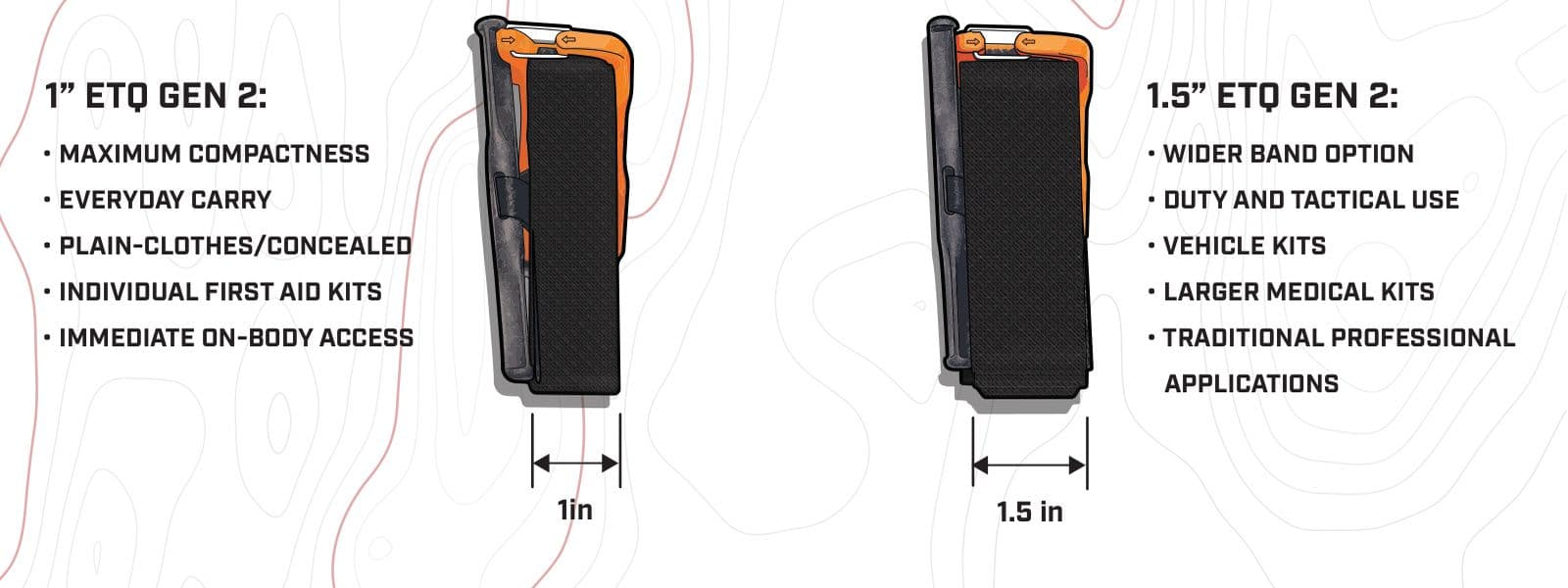
One of the most common questions we get about the ETQ is also one of the simplest:
Which one should I get: the 1-inch ETQ or the 1.5-inch ETQ Wide?
The short answer is that both are designed to accomplish the same fundamental task: to stop life-threatening extremity bleeding by arterial occlusion.
But tourniquet width does matter.
A wider tourniquet distributes pressure over a larger surface area and can achieve arterial occlusion at lower pressure than a narrower one under comparable conditions. A narrower constricting band concentrates pressure over a smaller area.
That doesn't automatically make one better than the other.
It means the better choice depends on where you're going, how you're carrying your medical equipment, and how long you might have to wait for definitive medical care.
1-Inch vs. 1.5-Inch Tourniquet: Quick Comparison
| Consideration | 1" ETQ | 1.5" ETQ Wide |
|---|---|---|
| Constricting band width | 1 inch | 1.5 inches |
| Primary advantage | Minimum size and weight | Wider pressure distribution |
| Staged dimensions | 1.8" W x 4.7" H x 1.2" D | 2" W x 4.7" H x 1.2" D |
| Weight | 1.4 oz. | 1.8 oz. |
| Best suited for | EDC, urban/suburban use, compact medical kits | Remote travel, outdoor use, duty kits, austere environments |
| Carry priority | Smallest practical footprint | Wider constricting surface |
| Snakestaff recommendation | When compact everyday carry is the priority | When prolonged evacuation may be more likely |
The difference isn't simply "small versus large." It's a matter of choosing the tool that makes sense for the environment in which you expect to use it.
Why Does Tourniquet Width Matter?
To understand tourniquet width, you first have to understand what a tourniquet is actually doing.
A tourniquet stops severe extremity bleeding by applying enough circumferential pressure to compress the underlying vessels and occlude arterial blood flow.
Width affects how that pressure is distributed.
Generally, a wider tourniquet can distribute the required force over a larger area of tissue and achieve arterial occlusion at a lower pressure. A narrower system concentrates pressure over a smaller surface area.
But there is another important distinction that often gets overlooked when comparing commercial tourniquets:
The width you see isn't necessarily the width doing the constricting.
A 1.5-Inch Tourniquet Isn't Necessarily Applying 1.5 Inches of Constriction
This is relevant when people compare the 1-inch ETQ to traditional full-size windlass tourniquets.
Take the Combat Application Tourniquet, or CAT.
Its exterior strap is approximately 1.5 inches wide, but the CAT uses a narrower internal tensioning band. When the windlass is turned, the internal component generates the circumferential constriction.
That means comparing tourniquets solely by measuring their exterior webbing doesn't necessarily tell you how wide the actual constricting mechanism is.
This was one of the considerations behind the original 1-inch ETQ.
We weren't simply taking a conventional tourniquet and arbitrarily narrowing it. We were looking at how established windlass tourniquets actually generate the pressure required for arterial occlusion and determining how small we could make the system without sacrificing its intended function.
Why Make a 1-Inch Tourniquet?
The original purpose of the ETQ was straightforward:
Make an effective tourniquet small enough for ordinary people to actually carry.
That changes the design priorities.
A military medic working from a medical kit, a patrol officer wearing a duty belt, and a civilian carrying medical equipment in normal clothes don't necessarily have the same requirements.
For civilian EDC, size and weight matter because every additional piece of equipment competes for limited space.
The 1-inch ETQ Gen 2 weighs 1.4 ounces and measures approximately 1.8 inches wide, 4.7 inches high, and 1.2 inches deep when staged.
That compact footprint makes it easier to incorporate into everyday carry rather than relegating the tourniquet to a backpack, vehicle, or trauma kit.
For someone living and working in an urban or suburban environment where EMS and medical care are generally closer, that tradeoff makes sense to us.
If the objective is having a tourniquet physically on your body every day, the 1-inch ETQ is our most compact option.
When Does a 1.5-Inch Tourniquet Make More Sense?
There are situations where we prefer the wider option.
The ETQ Wide uses a true 1.5-inch constricting band, rather than simply placing wider exterior material around a narrower internal tensioning mechanism.
That wider surface distributes the force required to occlude an artery across more tissue.
Why might that matter?
Consider someone hunting several miles from a trailhead, working in a remote area, traveling overland, operating in an austere environment, or working somewhere where medical evacuation could take substantially longer than it would in a city.
In those situations, prolonged application becomes a more realistic consideration.
Research involving tourniquet pressure generally shows that increasing cuff width can reduce the pressure required to achieve arterial occlusion. Pressure, duration, limb circumference, application technique, and other factors can all influence the physiological effects of tourniquet use.
That's why our recommendation changes as evacuation time increases.
If you're building a medical setup specifically for remote or austere environments, the 1.5-inch ETQ Wide makes sense.
Does That Mean a 1-Inch Tourniquet Is Less Effective?
No. Width by itself doesn't determine whether a tourniquet works.
The relevant question is whether the device can reliably achieve arterial occlusion when properly applied.
Snakestaff has conducted and commissioned testing of the ETQ platform, including human-subject testing using Doppler and ultrasound to confirm arterial occlusion.
Width changes the mechanics of pressure distribution. It does not create a simple dividing line where 1.5-inch tourniquets work, and 1-inch tourniquets don't.
That's also why comparisons based entirely on exterior dimensions can be misleading.
You need to look at the complete system.
What About CoTCCC Recommendations?
This comes up frequently in discussions about the 1-inch ETQ.
The ETQ and ETQ Wide are not currently CoTCCC-recommended tourniquets, and we don't represent them as such.
The Committee on Tactical Combat Casualty Care develops evidence-based recommendations for battlefield trauma care. Those recommendations are particularly important for military organizations operating within the TCCC system.
The original 1-inch ETQ wasn't developed specifically to meet a military procurement requirement. Its design objective was mass adoption in the civilian space by making an effective windlass tourniquet substantially easier to carry.
The ETQ Wide addresses a different set of priorities.
It retains the compact architecture of the ETQ while incorporating a true 1.5-inch constricting band for users and organizations that prefer a wider system.
We continue to collect testing data and real-world experience with both platforms rather than representing either product as having a recommendation it does not currently have.
Which ETQ Should You Get?
For most people, the decision can be narrowed down to one question:
Where are you most likely to have to use it?
If you live, work, and travel primarily in populated areas where EMS response and transport to higher-level medical care are relatively accessible, the 1-inch ETQ gives you the smallest and lightest package.
If you're routinely in remote areas where evacuation could take substantially longer, the 1.5-inch ETQ Wide gives you a wider constricting surface while maintaining the compact footprint that defines the ETQ platform.
Neither eliminates the need for training nor changes the basic priorities of treating life-threatening hemorrhage.
| If your priority is... | Consider... |
|---|---|
| Minimum EDC footprint | 1" ETQ |
| Pocket carry | 1" ETQ |
| Urban/suburban everyday carry | 1" ETQ |
| Wider pressure distribution | 1.5" ETQ Wide |
| Remote outdoor use | 1.5" ETQ Wide |
| Austere or prolonged evacuation environments | 1.5" ETQ Wide |
| Duty or larger medical kits where size is less important | 1.5" ETQ Wide |
Width Matters. Context Matters More.
So, does tourniquet width matter?
Yes, but not in isolation.
Wider bands distribute pressure across a larger surface area. Narrower systems concentrate that pressure into a smaller footprint, offering significant advantages for everyday carry.
The right choice depends on what you're preparing for.
For someone carrying medical equipment every day around town, we designed the 1-inch ETQ to provide the smallest practical footprint while still achieving arterial occlusion.
For someone headed farther from definitive care, or who simply prefers a wider constricting band, we developed the 1.5-inch ETQ Wide.
The objective isn't to win an argument over one inch versus 1.5 inches.
It's to make sure you have an effective tourniquet with you when you actually need one.