
Pocket Tourniquet vs. Full-Size: What Actually Matters for Civilian EDC
Full-size or compact misses the question that decides whether a tourniquet helps anyone: will it be on you when it is needed? Why carryability is a performance characteristic for civilian EDC.
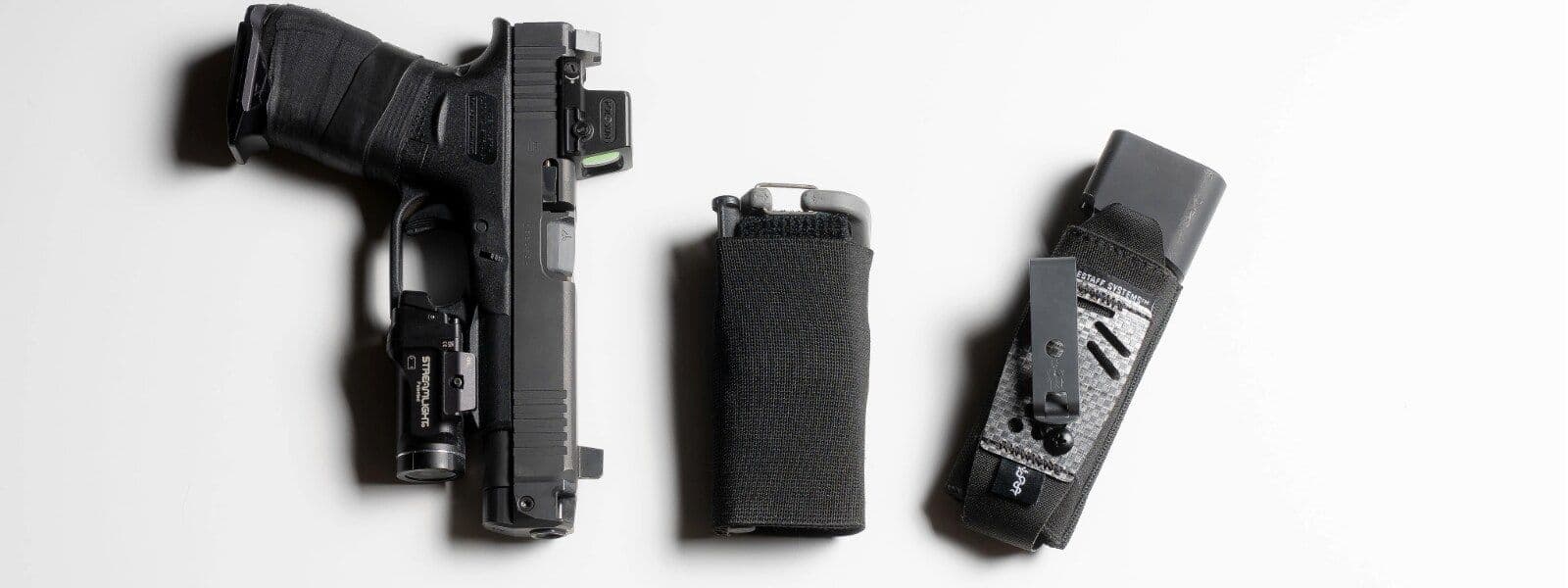
When choosing a tourniquet for everyday carry, it is easy to turn the discussion into a comparison of size and what-ifs.
Full-size or compact? One-inch or 1.5-inch? Pocket carry or a dedicated pouch?
Those differences matter, but they miss the most important consideration for civilian EDC: Will you actually have the tourniquet with you when you need it?
A full-size tourniquet stored in a trauma kit is valuable when that kit is within reach. But if your medical gear is in your vehicle, range bag, or backpack when a life-threatening bleed occurs somewhere else, its effectiveness becomes irrelevant.
The tourniquet in your pocket beats the one you left at home.
What Makes a Good EDC Tourniquet?
A tourniquet intended for everyday carry has to solve two different problems.
First, it has to do its job. A smaller footprint cannot come at the expense of the tourniquet's ability to occlude arterial blood flow when properly applied.
Second, it has to be practical enough to carry consistently.
That second requirement is where civilian EDC differs from carrying medical equipment on a duty belt, plate carrier, or dedicated trauma kit. Most people aren't walking around with plate carriers, duty belts, and assault packs.
They're carrying a wallet, phone, keys, pocketknife, flashlight, concealed firearm, or some combination of them. Eventually, space and comfort matter.
That was the problem we set out to solve with the ETQ Gen 2.
The goal wasn't simply to make a small tourniquet. It was to reduce the footprint without reducing its efficacy as a tourniquet.
The Glock 43X Approach to Tourniquets
For shooters, there is an easy way to think about it.
A Glock 17 is an effective handgun. So is a Glock 19. So is a Glock 43X.
The difference is how easily each one integrates into your daily life.
A Glock 17 isn't inherently a bad choice because it is larger. But plenty of people find a Glock 19 or 43X easier to conceal and therefore easier to carry consistently.
We approached the ETQ the same way.
Think of the standard 1-inch ETQ as the Glock 43X of tourniquets. The 1.5-inch ETQ Wide is closer to the Glock 19. A traditional full-size tourniquet such as the CAT occupies the Glock 17 end of the spectrum.
All can serve the same fundamental purpose. The EDC question is which one you're actually willing to keep on your body every day.
Pocket Tourniquet vs. Full-Size Tourniquet
There is nothing inherently wrong with a larger tourniquet.
Full-size tourniquets have an established place in military, law enforcement, EMS, range medical kits, vehicles, and trauma bags. If you're wearing a duty belt or carrying an IFAK, the additional bulk may not matter.
Civilian EDC presents a different problem.
You're trying to keep lifesaving equipment immediately accessible without turning normal clothing into a load-bearing system.
A pocket tourniquet reduces the barrier to carrying one.
The ETQ Gen 2 Regular weighs 1.4 ounces and measures approximately 1.8 inches wide by 4.7 inches high by 1.2 inches deep when staged. The ETQ Wide increases the constricting band from 1 inch to 1.5 inches while maintaining a compact overall footprint.
That makes either version practical for a pocket, waistband, belt, bag, or other EDC location.
More importantly, it makes carrying a tourniquet every day realistic.
Accessibility Is Part of Your Medical Plan
People often think about emergency medical equipment in terms of what they own.
A better question is what you can reach?
You might have a well-stocked trauma kit in your truck. That's useful if the emergency happens near your truck.
What happens when you're inside a grocery store?
At your kid's soccer game?
Walking through a parking lot?
Working around the house?
Responding to an accident before EMS arrives?
Severe bleeding doesn't give you the luxury of retrieving equipment from somewhere else. If a tourniquet is warranted, immediate access matters.
That principle applies whether you're a concealed carrier, a police officer, a tradesman, a parent sitting on the sidelines at a soccer game, or someone who simply wants to be better prepared.
Medical equipment left outside immediate access has limited value. Seconds count when first responders are minutes away.
Carry Medical Equipment Like You Carry Other Tools
For people who carry a firearm, this concept should already be familiar.
A firearm is a tool intended to be available during an extremely unlikely but potentially catastrophic event. You don't know when you'll need it, which is precisely why accessibility matters.
A tourniquet should be viewed through the same lens.
In fact, there are plenty of situations requiring bleeding control that have nothing to do with firearms.
Vehicle crashes. Workplace accidents. Power tools. Outdoor recreation. Broken glass. Machinery. Serious household injuries.
The purpose of an EDC tourniquet isn't to predict which emergency you're going to encounter. It's to have an appropriate tool immediately available if severe extremity bleeding occurs.
That requires more than buying one.
It requires carrying it.
Does Smaller Mean Less Effective?
It shouldn't.
Compactness only has value if the underlying medical device can still perform its intended function.
That distinction was central to development of the ETQ. The objective wasn't to create the smallest object we could call a tourniquet. It was to build a functional windlass tourniquet around a footprint people would realistically carry.
The current ETQ platform has undergone human-subject performance testing using Doppler and ultrasound to confirm arterial occlusion. We continue to collect performance data and real-world use information as the platform develops.
The ETQ and ETQ Wide are not currently CoTCCC-recommended tourniquets, and we don't represent them as such. CoTCCC recommendation is a specific evaluation within the Tactical Combat Casualty Care system rather than a blanket determination of whether every tourniquet outside its current recommended-device list is effective.
For civilian EDC, the important point is simpler: smaller should never mean accepting a tourniquet that cannot perform the job you're carrying it to perform.
Size is a carry advantage, not a substitute for performance.
ETQ or ETQ Wide: Which Makes More Sense for EDC?
For most people, the decision comes down to how they intend to carry it.
The 1-inch ETQ provides the smallest footprint and is the logical choice when maximum concealability and minimum bulk are the priorities.
The 1.5-inch ETQ Wide provides a wider constricting band while remaining substantially focused on compact carry. For someone willing to accept a little more width in their EDC setup, it offers a middle ground between minimum footprint and a wider tourniquet.
Neither choice changes the underlying philosophy.
Carry the version that fits your needs well enough that it actually stays with you.
The Best EDC Tourniquet Is the One You Will Carry
There isn't much value in building an impressive EDC medical setup that becomes inconvenient enough to leave behind.
That's why size matters.
Not because smaller automatically means better. Not because traditional full-size tourniquets don't work. And not because everyone needs exactly the same equipment.
Size matters because carryability affects availability.
From the soccer mom at Saturday's game to an officer beginning a patrol shift, the objective is the same: have effective bleeding-control equipment close enough to use immediately.
That's the reason we developed the ETQ.
We wanted a tourniquet that could disappear into normal everyday carry without sacrificing the reason you're carrying a tourniquet in the first place.
Because when severe bleeding occurs, the best EDC tourniquet isn't sitting in your truck, range bag, or trauma kit at home.
It's the one you have on you.